



 Just 30 kilometers (19 miles) east of Rome lies one of the greatest masterpieces of the Roman Empire—Hadrian’s Villa (Villa Adriana). More than an imperial residence, it was a vast city of palaces, temples, libraries, gardens, baths, fountains, theaters, and hidden passageways where Emperor Hadrian transformed his vision of the world into stone.
Today, this extraordinary archaeological complex is recognized as a UNESCO World Heritage Site and remains one of Italy’s most fascinating historical destinations. Unlike the bustling Colosseum or Roman Forum, Hadrian’s Villa offers visitors the rare opportunity to wander through peaceful ruins surrounded by cypress trees, olive groves, and the rolling countryside of Tivoli.
Whether you’re passionate about Roman history, architecture, archaeology, or simply looking for an unforgettable day trip from Rome, Hadrian’s Villa promises an experience unlike any other.
Hadrian’s Villa (Villa Adriana) is a vast imperial complex built between AD 118 and AD 138 by the Roman Emperor Hadrian in Tivoli, Italy. Covering more than 120 hectares (296 acres), it included luxurious residences, baths, libraries, temples, gardens, pools, theaters, and underground tunnels. Today it is one of the best-preserved examples of Roman architecture and a UNESCO World Heritage Site.
Why Did Emperor Hadrian Build Villa Adriana?
Many Roman emperors enjoyed lavish residences, but none created anything quite like Hadrian’s Villa.
After ascending to the throne in AD 117, Hadrian spent years traveling across the Roman Empire. Unlike many rulers who remained in Rome, he visited Britain, Greece, Egypt, Asia Minor, North Africa, and the Middle East. Everywhere he went, he admired local architecture, engineering, gardens, and religious traditions.
Inspired by these journeys, Hadrian envisioned a residence that would recreate the wonders of the empire in one place.
Some Ancient historians suggest he preferred the peaceful landscape of Tivoli to the political atmosphere of Rome’s Palatine Hill, where the traditional imperial palace stood. While it is impossible to know whether he truly disliked the Palatine residence, there is no doubt that Villa Adriana became his favorite retreat and administrative center during the later years of his reign.
Rather than building a simple country house, Hadrian commissioned an extraordinary complex that blended Roman engineering with Greek elegance and Egyptian symbolism.
The result was one of the largest and most luxurious villas ever constructed in antiquity.
Did You Know?
Hadrian’s Villa was so large that historians often describe it as an imperial city rather than a villa. At its peak, it housed members of the imperial court, soldiers, servants, architects, artists, scholars, and guests from across the Roman Empire.
Where Is Hadrian’s Villa?
Hadrian’s Villa is located in Tivoli, a picturesque hill town in the Lazio region of central Italy.
Known since ancient times for its fresh mountain air and abundant natural springs, Tivoli became a favorite retreat for Roman aristocrats seeking relief from the summer heat of Rome.
Even today, visitors can combine a trip to Hadrian’s Villa with other remarkable attractions, including:
· Villa d’Este, famous for its spectacular Renaissance fountains
· Villa Gregoriana, a romantic park with waterfalls and caves
· The Temple of Vesta
· The Temple of the Sibyl
· Tivoli’s medieval old town
Together, these landmarks make Tivoli one of the most rewarding day trips from Rome.
A Masterpiece of Roman Architecture
Walking through Hadrian’s Villa feels like exploring an entire ancient city.
The estate once featured: Imperial palaces, Reception halls, Private apartments,Libraries,Thermal baths, Decorative fountains, Artificial lakes, Sacred temples,Theaters,Banquet halls,Underground service tunnels, and Beautiful landscaped gardens.
Four Roman aqueducts—including Anio Vetus, Anio Novus, Aqua Marcia, and Aqua Claudia—supplied fresh water to countless pools, baths, fountains, and ornamental canals.
This sophisticated hydraulic system allowed water to become one of the villa’s defining architectural elements, creating reflections, movement, and cooling effects throughout the estate.
Did You Know?
Many of the underground tunnels at Hadrian’s Villa were designed so servants, guards, and supplies could move around the estate without disturbing the emperor or his guests. This innovative system kept the luxurious gardens and ceremonial spaces peaceful while the daily operations of the imperial household remained hidden from view.
The Canopus and the Serapeum: Egypt in the Heart of Italy
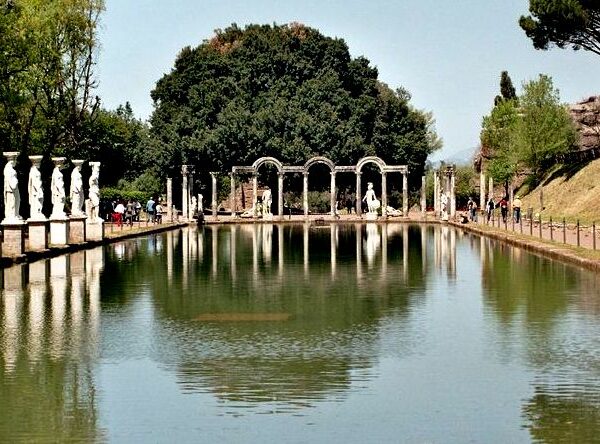 Among the villa’s most breathtaking features is the Canopus, a long reflecting pool inspired by the ancient Egyptian city of the same name.
Emperor Hadrian admired Egyptian culture during his travels along the Nile, and he recreated its atmosphere within his Italian retreat. Lined with elegant Corinthian columns and statues representing Greek and Roman deities, the pool reflected the surrounding architecture in a dazzling display of symmetry and light.
At the end of the Canopus stands the Serapeum, a monumental dining pavilion dedicated to Serapis, the Greco-Egyptian god who symbolized the fusion of cultures throughout the Roman Empire.
The Serapeum’s graceful dome, decorative niches, flowing fountains, and shaded terraces made it the perfect setting for lavish summer banquets. Archaeological discoveries suggest that hidden service areas and kitchens allowed servants to prepare elaborate feasts while remaining out of sight, creating an experience that combined luxury, engineering, and theatrical presentation.
Standing beside the tranquil waters today, it’s easy to imagine the emperor entertaining distinguished guests against a backdrop of shimmering reflections, marble sculptures, and the soothing sound of flowing water.
The Canopus was not simply decorative. Its design combined architecture, symbolism, and water engineering to create one of the most sophisticated leisure spaces of the Roman
The Maritime Theatre: Hadrian’s Private Island Retreat
Among the many wonders of Hadrian’s Villa, none is more intriguing than the Maritime Theatre (Teatro Marittimo). Despite its name, it was never a theater. Instead, this remarkable circular structure served as the emperor’s most private sanctuary—a place where he could withdraw from court life, reflect, read, write, or meet only his closest advisors.
The complex consists of a circular canal surrounding a small artificial island connected by two movable wooden bridges. On the island stood a miniature villa complete with living quarters, baths, a library, porticoes, and a private garden. The ingenious design created both physical and symbolic separation from the outside world.
Historians believe this was Hadrian’s personal retreat within his already secluded estate. While the Roman Empire stretched across three continents, the emperor could escape the pressures of ruling millions of people by crossing a simple bridge into his own peaceful refuge.
Architecturally, the Maritime Theatre demonstrates Hadrian’s fascination with geometry and innovation. The perfect circular layout, harmonious proportions, and sophisticated engineering reveal why many scholars consider it one of the earliest masterpieces of experimental Roman architecture.
Did You Know?
Many architects describe the Maritime Theatre as one of the world’s first examples of a private luxury retreat, centuries before the concept of exclusive island villas became popular among modern elites.
Piazza d’Oro: The Golden Square
One of the most elegant parts of Villa Adriana is the mysterious Piazza d’Oro, or “Golden Square.” Despite its modern name, no evidence suggests it was literally covered in gold. Instead, archaeologists believe the name reflects the extraordinary richness of its decoration. Marble columns, colorful mosaics, fountains, sculpted gardens, and richly decorated reception rooms once surrounded a spacious central courtyard.
The complex was likely reserved for imperial ceremonies and distinguished guests. Every architectural element was carefully arranged to impress visitors with the emperor’s wealth, taste, and command of the world’s finest artistic traditions.
Fragments of rare marbles from Greece, Egypt, Asia Minor, and North Africa discovered throughout the villa demonstrate the vast trade networks available to Rome during Hadrian’s reign. Rather than relying solely on local materials, the emperor imported luxurious stones from across the Mediterranean, transforming the villa into a showcase of imperial prosperity.
Today, although many decorative elements have disappeared, the elegant proportions and carefully planned layout still hint at the magnificence that once greeted diplomats, philosophers, military leaders, and members of the imperial family.
Antinous: The Emperor’s Greatest Love
No story connected to Hadrian’s Villa is more moving than that of Antinous, the young man whose memory became inseparable from the emperor’s legacy.
Antinous, believed to have come from Bithynia in present-day Turkey, accompanied Hadrian on many of his journeys throughout the empire. Ancient sources describe him as exceptionally handsome and highly respected within the imperial court.
In AD 130, tragedy struck during a voyage along the Nile River in Egypt. Antinous drowned under circumstances that remain one of history’s greatest mysteries. Some ancient writers believed it was an accident, while others suggested ritual sacrifice or even political intrigue. No definitive explanation has ever been found.
Hadrian was devastated.
His grief was unlike anything previously recorded for a Roman emperor. He founded the city of Antinoopolis in Egypt, established a cult honoring Antinous, commissioned hundreds of statues in his likeness, and promoted his worship throughout the empire.
Many sculptures of Antinous discovered at Hadrian’s Villa reveal the emperor’s deep emotional attachment. Today these masterpieces are displayed in museums around the world, including the Vatican Museums, the Capitoline Museums, and the Louvre.
Their serene expressions and idealized beauty continue to fascinate visitors nearly two thousand years later.
Did You Know?
Antinous became one of the most frequently depicted individuals in Roman art, second only to members of the imperial family. More than one hundred statues and portraits of him survive today.
Water: The Soul of Villa Adriana
Water was far more than decoration at Hadrian’s Villa—it was an essential part of its identity.
Fed by four major Roman aqueducts, the estate featured reflecting pools, ornamental canals, fountains, waterfalls, thermal baths, and sophisticated hydraulic systems that amazed ancient visitors.
Running water cooled the summer air, reflected monumental architecture, masked everyday sounds, and created an atmosphere of tranquillity. Engineers carefully controlled water pressure using gravity alone, an extraordinary achievement considering the technology available in the second century AD.
The Canopus remains the villa’s most famous water feature, but smaller fountains and pools were scattered throughout the estate, transforming every walk into a multisensory experience of sound, movement, and light.
Hadrian’s Architectural Vision
 Unlike earlier emperors who preferred traditional Roman styles, Hadrian embraced cultural diversity.
His travels influenced nearly every corner of the villa:Greek temples inspired elegant colonnades.Egyptian monuments influenced the Canopus and Serapeum.Roman engineering made enormous domes and vaults possible.Eastern decorative motifs appeared in mosaics and marble inlays.Landscaped gardens blended architecture with nature in unprecedented ways.
Rather than copying foreign monuments exactly, Hadrian combined ideas from across the empire into a uniquely Roman masterpiece. Villa Adriana became a living expression of the emperor’s belief that Rome’s strength came from embracing different cultures while uniting them under one civilization.
A UNESCO World Heritage Site
In 1999, UNESCO inscribed Hadrian’s Villa on the World Heritage List, recognizing it as one of the most important archaeological sites in the world.
According to UNESCO, the villa represents the finest surviving example of an imperial Roman residence and demonstrates an exceptional fusion of architecture, engineering, landscape design, and artistic innovation.
Unlike many archaeological sites that preserve only fragments of ancient life, Villa Adriana offers visitors an unusually complete picture of how an emperor lived, governed, entertained guests, and sought inspiration from the cultures of his vast empire.
Its influence extended far beyond antiquity. Renaissance architects, including those who designed some of Europe’s greatest palaces and gardens, studied Hadrian’s Villa for inspiration. Even today, architects and landscape designers continue to draw ideas from its harmonious relationship between buildings, water, and nature.
Did You Know?
Many treasures originally discovered at Hadrian’s Villa—including statues, mosaics, and decorative marble—are now displayed in museums across Italy and Europe, helping scholars reconstruct the appearance of the estate at the height of its splendor.